The Arnolfini Portrait by Jan Van Eyck (1434)
Description
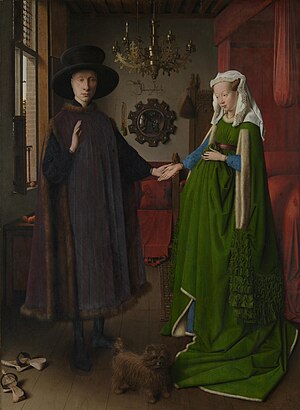
This is a portrait made by Jan Van Eyck in 1434, an oil painting on an oat panel. It is from the Northern Renaissance era. The portrait features Giovanni di Nicoloa, an Italian merchant, and his wife. They are in their Flemish home, and it is unclear if she is pregnant or not. It is said that the couple had just spoke their vows, and the painting is also known as, “Arnolfini Marriage” or “The Arnolfini Wedding.” It could have been painted as a legal document witnessing their marriage (Jones, 2000). It is the oldest famous oil painting, and was purchased by the National Gallery in London in 1842 (Takac, 2019).
Opinion/Reaction
This portrait amazes me because it was created so long ago, but has so much detail and precision. I honestly didn’t know that this long ago there were even resources to create this type of art. This honestly wouldn’t be an art piece that I’d initially be interested in, it just doesn’t catch my eye, but when I actually analyzed it, and noticed all of the different details, I was blown away. I didn’t notice the dog in front of the couple until the article, “The Arnolfini Portrait – Jan van Eyck’s Greatest Riddle,” by Balasz Takac (2019) pointed it out. I feel that the background doesn’t really take away or emphasize the main part of the picture, it all is just kind of included and apart of the picture. Everything is placed in a very real way, but giving the couple the center, proving that they are the main piece. The images in the portrait are nicely spaced. The emotion this image gives me is eerie. The picture’s tone is dark, and the husband and wife don’t look happy or sad, they just look blank. The colors used don’t really grab my attention. I have noticed though in old portraits that people tend to not have any facial expressions. It just looks mysterious to me. Even though the oil painting is a historical, famous image, I would not own a copy of it, it just isn’t my style.
The Reinvention of Rome by the Catholic Church
The reinvention of the Catholic churches began to rise in the 15th century, and before it was on the downfall. Whenever I see a Northern or Italian Renaissance picture, I automatically think of the rise of the Catholic churches, that is why I chose to relate this image to it. The popes used their power to strengthen Rome, and artwork was a huge part of the reinvention as well. It is interesting to me how so many art pieces in the Renaissance era were based on the church. It is crazy to think that this image created by Jan Van Eyck was before the Catholic churches began tremendously rising again. Most images from the Renaissance era are related to the Catholic church in some way it seems, but I cannot find any indications of the church in the Armolfini Portrait by Jan Van Eyck, and that is what I am curious about. The Northern humanists did believe that the Catholic church was a way to better their lives. In your opinion, is this image connected to the reinvention of Catholic churches?
Jonathan Jones. Arnolfini Portrait, Jan Van Eyck (1434). April 15, 2000. Retrieved from:
https://www.theguardian.com/culture/2000/apr/15/art
Balasz Takac. The Arnolfini Portrait – Jan van Eyck’s Greatest Riddle. April 21, 2019. Retrieved from:
https://www.widewalls.ch/arnolfini-portrait-jan-van-eyck/
Catholic Church in the Renaissance. Retrieved from:
https://all-about-renaissance-faires.com/renaissance/catholic_church_in_the_renaissance/


Bethany,
I found this online in regards to the Renaissance Blog assignment. It’s relevant to what you chose for it. https://www.tandfonline.com/doi/abs/10.1080/1051144X.2018.1532675
LikeLike
Bethany,
I can understand when you say this piece of art isn’t your style and that you wouldn’t own a copy of it yourself, however, I am enjoying taking a closer look at it and evaluating it myself. The couple is definitely emotionless.
My opinion is that this piece could quite possibly be connected to the reinvention of churches especially if it was to capture their vows.
I also have to point out that the disproportion in this pice is so obvious to me I am truly blown away, thank you for sharing.
LikeLike